Saturday, February 1, 2014

Resource: Work//Power


In this video you will listen a man explain what work and power are and how theyre related to each other. As we know, work=Force*distance and power=work/time. This video is really great because the man gives example problems in order for us to understand what hes talking about and he shows various images which is helpful. 
This video is useful to what were learning in physics because if you didn't understand it before, this man runs through various exercises to make it clear.

Monday, January 27, 2014

UNIT 4: Blog Reflection

Unit four is based off of Hewitt's Conceptual Physics textbook: Chapter 8.

First, we covered distance and speed involved with circular motion.

Linear speed is the same thing as just saying speed. Speed is the distance traveled over a unit of time. When you travel a greater distance it means you are increasing your speed as well. Remember it like this: greater distance means greater speed.
Tangential Speed is the linear speed of an object moving along a circular path. This could be for example, a car or a merry go round. The direction of the object's motion is tangent to the circumference of the circle.
Then we learned about rotational speed also called angular speed. This is the calculation of the number of rotations an object does over a unit of time. The unit used in rotational speed is RPM (rotations per minute). When you have a greater RPM, it is faster in speed.

The sentence before this one, proves that tangential speed is directly proportional to rotational speed.

Furthermore, there are two different types of relationships between tangential and rotational motion.

  1. Same tangential, different rotational
    • ie: Gears
      • The rotational speeds are different because of the size of each gear and the tangential speeds are the same because they are traveling along the same number of knots because they are all connected and they are covering the same distance in the same amount of time.
Different Size Gears//all connected
    2. Same rotational speed, different tangential speed
    • ie: whips//train wheel design
      • The rotational speeds are the same but the tangential speeds are different because of the distance from the axis of rotation.
Secondly in this unit we covered Rotational Inertia//Conservation of Angular Momentum

Once again, we know that inertia is the property of an object to resist changes in motion. Inertia is measured in mass.
But moving forward, we have to know about rotational inertia. Rotational inertia depends on the distribution of mass and also the property of an object to resist changes in the spin. If there is more rotational inertia it is harder to spin, if there is less, it is easier to spin. 
In class, we did a demo with rulers and lead weights. On one ruler, we attached two lead weights to each end and on the other ruler we attached two lead wights really close to the center of the ruler. The ruler with the weights closer was much easier to spin therefore it has a small rotational inertia. The one with the weights on each end was much more difficult to spin, so it has a larger rotational inertia. 
The main question with rotational inertia is: How far is it from the axis of rotation?
Arms spread out: Far from axis
Arms closer together: Close to axis
Along with this lesson we learned about the conservation of angular momentum. Previously we learned about regular momentum and the formula for that was momentum before=momentum after. In this lesson, it is the same! Angular momentum before=angular momentum after.
The formula for angular momentum is: (rotational inertia)(rotational velocity)=(r.i)(r.v)

When there is bigger rotational inertia, the rotational velocity is smaller and vice versa.

Another thing we learned is about torque, not to be confused with the famous dance move twerk.
Torque is a force that causes rotation. Torque involves two different thing: force and a lever arm. This is how we get the formula for torque. Torque=force*lever arm
Torque on a balance. Where it says torque arm, replace with lever

Something that is super important about this concept is that the force and lever arm must be perpendicular; no exceptions.
The lever is basically the distance from the axis of rotation.
Base of support is the idea that if it wont fall there is no torque. In order for this to happen, we want a large base of support.

A concept following torque was center of gravity//mass
Center of gravity is when gravity acts on the center of mass. Gravity is also a force.
Center of mass is the idea that all objects have an average position of all their mass. This is what causes us to rotate and fall down.

The last lesson of this unit included centripetal//centrifugal force. In order to talk about this lesson we must review what inertia is again. To restate, it is the property of an object to resist changes in motion. Inertia is measured in mass.
Centripetal force is a center seeking force which is the only force acting on you.
Centrifugal force is a center-fleeing force which is fictional. it is not an actual force. What it really is, is a feeling that you are being pushed outward. Look at the image below to distinguish the two, but remember centrifugal is fictional so it doesn't really exist.

Examples of centripetal forces are: satellites that remain close to the Earth, washing machine holes, roller coasters, race cars on the race track etc.

The Difficulty
The only thing that was difficult about this unit is being forced to think that in the torque equation, we have to remember that there is a lever arm and not only the force. Also in the beginning the train question was pretty difficult to understand and to be honest, I just learned it today!
I overcame these difficulties by going to Ms. Lawrence during my free period and asking questions and telling her what I knew, which was super helpful. I think all I needed was some clarification. 

Effort, Learning, Problem Solving
Effort: in class, I feel like I participate enough to understand the concepts that we are learning and to possibly clarify for my peers as well. Homework wise, I stay on top of my work and have not missed one assignment since the semester started. In the one lab we've done so far, I was the one who worked past school hours in order to figure out the answer for my group. I've completed ever blog post and commented on Hunter's blog every time. 
Learning: I used to be kind of bad at verbalizing what I was thinking and the concepts we learned in physics. By going to Ms. Lawrence's class, I've learned to speak the lessons we've learned and also translate them to the paper. Thus, my self confidence has risen a lot because I feel like now I know what I'm saying and I'm not only putting it on the paper. My patience level definitely went up as well because I know that when I don't understand a concept, I will be able to understand in a matter of 24 hours by seeing Ms. Lawrence outside of class. 

Goals
My goal for the next unit is to keep doing the things I've been doing so far if they help me do well on the test that is coming up. 

Connections
Rotational inertia relates to my everyday life because I used to be a dancer and now I understand why my dance teacher would tell us to tuck our arms in in order to go faster. 
Centrifugal force relates to every day life when I ride roller-coasters at amusements parks during the summer..i'll be thinking about physics next time I ride one. 

Podcast:
Here is our podcast! Enjoy!

Tuesday, January 21, 2014

...meter stick...

Goal: To find the mass of a meter stick and a 100 g lead weight.
A 100g lead weight, is one individual circle from the image above

Step #1 was basically a demonstration to learn how to balance a meter stick on a table. We attempted this three different times, each time was very different.

In our first demo, the meter stick was not balanced on the edge of the table, which meant it had a torque because torque is lever arm times the force. We got results that looked like this:

Image from Notes

In our second demonstration, the meter stick was now balanced at the edge of the table. We figured out that the edge of the table and the center of gravity related because the center of gravity was sitting right on the edge of the table. It looked just like this:
Image from Notes


And then there was demonstration C; we added a 100g lead mass to the ruler and we had to balance the forces so that we could see the clockwise and counterclockwise torque. That looked like this:
Image from Notes


Step #2 was the "planning" stage before we got to do anything. We wrote down our initial plans to solve the challenge. This was what we came up with:

  • w=mg
  • torque=force*lever arm
  • 100 g = 1 kg (this was for the lead weight)
  • We would use w=mg to get any weight of the objects and we use the torque formula when we are balancing the stick and trying to find the clockwise torque.
Step #3: the real deal
This was the part when we used step #2 in order to try out the plan to see if it would work.

ATTEMPT #1

Our first attempt was putting the meter stick (100cm) at the 50 centimeter mark and putting the 100 gram weight on it...if you try this, it immediately falls. It does not balance because the lead weight exerts such a large force on one side only. As you can see in the image below, someone had to catch it because it would not have balanced on its own. Therefore, it failed.


Calculations:
w=mg
w=(.10)(9.8)
w=.98

torque=force*lever arm
torque=(9.8)(50)
THIS IS WRONG. Calculations failed because we did not try to balance the meter stick at all.

ATTEMPT #2

Our second attempt involved us putting the measuring stick on the table and putting the lead weight on it and keep shifting it around until it balanced perfectly. This procedure worked. Below you will see what it looked like:

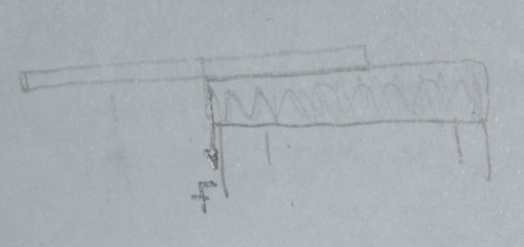
In the image above, the red arrow represents the force that gravity is putting on this object. The yellow lines show the lever arm of the ruler which you will see when you look own to the calculations. The black dot is only showing that that is the center of gravity.

Calculations:
w=mg
w=(.10)(9.8)
w=.98kg

torque=force*lever arm
torque=(.98)(22.7)
**the way we got 22.7 was by subtracting 77.3 from 100 because that is the length of the lever arm from the meter stick
torque=22.25 Nm

This is not the final answer because we are trying to find the weight of the meter stick.

torque=force*lever arm
22.25=28F
Divide by 28 on both sides.
F= .79
Now that we have the force of the other side, we need to figure out the weight

w=mg
.79=m(9.8)
Divide by 9.8 on both sides
.081kg 
We must convert this back to grams and that gives us 81 grams. THIS IS THE WEIGHT OF THE RULER


Thursday, January 16, 2014

Resource: Twerk


This is a video that comes from the educational website, Brightstorm. This man does a good job of explaining what torque is and that it is a force that makes objects rotate, but what I found interesting was that he said on an axis..which is something we have not heard in class yet. 
This relates to physics because we are currently studying torque and this man reinforces most things we have learned.
Enjoy!

Friday, January 10, 2014

Resource: Angular Momentum!


This video that I just saw is probably my favorite/most useful video of the whole year. You are about to see different examples of angular momentum that come from daily life. Also the man will explain how to find their momentum and he will talk about why the different examples must bring their arms and legs closer to the axis of rotation in order to go faster.
This relates to physics because we can see examples that are moving to prove that it is real. Also something he said that was helpful was that the acrobat had to bring in his arms and legs if he wanted to go 4 times as opposed to the other girl who only went 2 times around because her legs were straight. If you're having trouble with this concept, this video is probably really going to help you! Have fun!


Monday, December 9, 2013

UNIT 3: Blog Reflection

Getting closer to the fall exams, I realized that this blog reflection has to be more than what I've done in the past. Hopefully, it does not get too boring :)

In this unit I learned about Newton's Third Law, Vectors, Tension, Force of Gravity, Tides, The relationship between Impulse and Momentum, the Conservation of Momentum...wow! That's a lot of topics I will be covering on this post, stick around! I'll take each one by one.

Newton's Third Law

Newton's Third Law explains that with every action there is an equal and opposite reaction. Newton is trying to say that all objects have a relationship/interaction. These are called action/reaction pairs. 
For example, take an apple sitting on a table: 
The apple is pulling the Earth up, while the Earth pulls the apple down. But if you want to get into logistics with the table included, there is a whole other relationship between either the apple and table or the earth and table. 
In order to create action/reaction pairs, there are three rules that must always be followed
  1. The verb must always remain the same (pulls/pulls, push/push, hit/hit)
  2. The direction that was stated first, must be opposite at the end (up/down, left/right)
  3. The object must stay the same and then switch 
Next, if someone were to ask the question "Which vehicle has the bigger force? A truck or a car?" I am assuming your immediate answer would be the truck just because it is bigger. Well this mentality is incorrect. As learned previously in Newton's Second Law, Force equals mass times acceleration.
 

This means that if there is a bigger mass, there will be a smaller acceleration and vice versa, if there is a larger acceleration, there will be a smaller mass. This is why the answer to the question stated above, is that they will have an equal force. WOW! 
This is showing how if there is a bigger mass (like the truck) there will be a smaller acceleration
This is also showing that if there is a smaller mass there will be a bigger acceleration (like the car)
Created on Paint 
Next, I learned about an essential question: Why does a horse pull a buggy?
Action/Reaction Pairs. Created on Paint -JL

So you might see a bunch of paired arrows in different colors. Well by the end, you should be able to know what descriptions go with each pair. 
Green Arrows: The force is pulling the buggy forward an the buggy is pulling the horse backward
Blue Arrows: The horse pushes the ground backwards and the ground pushes the horse forward
Red Arrows: The buggy pushes the Earth forward and the Earth pushes the buggy backward
Realize how I used the rules that I talked about earlier to make these action/reaction pairs.

A horse pulls a buggy with the same force the buggy pulls the horse because of Newton's 3rd Law that states with every action, there is an equal and opposite reaction. The reason the horse is able to pull the buggy is because it is able to push the ground harder.

Something you must remember in all of these instances that have a relationship like this is that whoever can push the ground harder will move in the direction they wish to go. This is because Earth pulls everything downward. Another example of a relationship like this would be a tug of war. 


Vectors

Vectors are a little hard to explain but they occur when two forces are perpendicular and when we are trying to find out in what direction an object or a person will go. 
Showing two perpendicular forces
Vectors show magnitude and direction. 
In order to create the middle arrow that will show you in which direction the object will go, you must draw a parallelogram like so:
Created on Paint
 The purple arrow represents the direction that the object will end up going in. 

This led into the next essential question: Why does a block slide down a ramp? 
Taken from my notes -JL
First we must know the different forces the box has on a ramp.
  1. Support force: a force that is always perpendicular to the surface
  2. Fweight/gravity which is pulling box down onto ramp
  3. It has a fnet which is sliding the box down the ramp
Looking at the image above, everything is labeled, except for the fnet which is the small blue arrow. When you draw a parallelogram, using the support force and the gravity vectors, that is what it provides you with. 

Tension

Disregard Numbers
Tension is the pulling force exerted by a string, cable, chain, or similar solid object on another object (Wikipedia). Tension shows how much force is being exerted on each side of a string and by calculating it, we know which side is most likely to break. 

To calculate tension:
  1. Draw an fweight
  2. Draw an fnet (which is equal and opposite to fweight)
  3. Draw a parallel line to each tension line
  4. Draw tension vectors 

Force of Gravity

In this section of the unit, I learned that everything with mass attracts all other thing with mass.
I learned that force depends on 2 things:
  1. Mass of objects
  2. Distance between two objects
Also, I learned that force is inversely proportional to force because of the inverse square law which is:
F~1/d^2
If you were to use this equation for any number, for example 1, this is what it would look like:
Problem for Inverse Square Law. Created on Paint
Subsequently, we learned about solving for gravitational force with the formula being:
I learned that G=6.67*10^-11 Nm^2/Kg^2. This is a super small number. This formula is universally accepted as the gravitational formula for force. 
Some other key points that may be important are:
  • you weigh less on Mt. Everest than at sea level because you are closer to the Earth's core. 
  • in case you don't know how to multiply numbers with powers of 10, here are some suggestions:
    • separate the whole numbers from the "10 to the whatever powers" 
    • if powers are multiplied, add them
    • if powers are divided, subtract them
    • if powers are squared, multiply them

Tides

Tides are caused the two sides of the Earth not experiencing the same force. This is why we have high tides and low tides. If you've ever been to the beach, you've probably realized that on some day the water is so high up to where you place your chair and at other times it is so low that you have to walk a far distance in order to get some water on your toes. 
There is a difference felt by the moon which is greater and this is what causes the tides. 
Also there are spring and neap tides which are displayed in the image below.


A spring tide is a tide just after a new or full moon when there is the greatest difference between high and 

low water.

A neap tide is a type of tide in which it occurs right after the first and third quarters of the moon when there is the least difference between high and low water.

Impulse and Momentum Relationship

The formula for momentum is p=mv. Something else that is crucial to this lesson is that the change in momentum is: pfinal - pinitial equals change in momentum. The change in momentum is the same regardless of if you stop quickly or slowly.

Impulse is the force upon something and how long force is applied.
The formula we use for impulse is J=F*change in t
And also impulse equals the change in momentum, which stated earlier is pfinal-pinitial.

An essential question we learned recently is Why do airbags keep us safe?
The answer to this question is super complex, but it gets easier with practice.
I am going to highlight the answer, and then after many different example problems, the answer should come easily.

The car will go from moving to not moving no matter how it is stopped therefore ∆p is the same no matter what.
J=∆p (this is the first formula) The impulse will be the same no matter how you are stopped.

J=F∆t
without airbag: J=F∆t
with airbag: J=F∆t
The airbag increases the time of the impulse therefore the force on you is less because small force equals less injury.

Some other examples of this type of problem would be:

  • Why does a climber prefer to use a stretchy cord over a metal one?
  • Why do padded dashboards make cars safer?
Therefore in all problems with this relationship, they equal each other.

Conservation of Momentum

In conservation of momentum, forces are equal and opposite. This directly relates back Newton's Third Law because he states that all forces must be equal and opposite.

Things I need to know for this unit:

  • p total before = p total after
We used carts to model this in a lab. 
We learned that when the carts did not stick together and kept going, the momentum was still conserved. This was shown with the formula
  • MaVa + MbVb = MaVa + MbVb
If the carts were to stick together when they met and kept going, the momentum was still conserved also. This was shown with the formula:
  • MaVa + MbVb = Ma+b(Vab)
In order to understand what these mean, it would be easier to know this in terms of a cart...which you can see in the image below
In the top one, they stick together
In the bottom image, they keep going in the opposite direction
Another example of the conservation of momentum is when things hit at an angle.
In this example, because it is in top view, we can assume that all of the momentum was in the x direction. If you're wondering what the y is, it is 0 kg m/s...so there is no y direction.
I mean, there is still some y momentum but they cancel out because they go in opposite directions.

If we add numbers to this..
The x direction at the end must be the same because, remember, momentum before must equal momentum after.

Another form of conserving momentum is in bouncing. There is double the change in momentum because it is going from moving to not moving because it is stopping and starting. For example:

The Difficulty

In this unit, I found tides extremely difficult and I am not sure why. The only thing I can think of is that my class was really distracted the day we went over it in class. Unfortunately, even when I came into conference period, I still did not understand it. I learned a little bit from my class peers' podcast at the end of the unit. 
I did not really overcome this difficulty, I just re-watched the video and looked at my notes and I am hoping that going into the test I will be okay. 

Effort, Learning, Problem Solving

In this unit, my effort during class stayed consistent. I think I didn't ask as many questions in class but i always came in prepared for class with my homework done and studied my notes from the night before. 
One thing I didn't do as well in, was my quiz taking abilities which scares me for the test because I don't know if I will have everything mastered by tomorrow when I will be taking my test in the conference room. In activities, I actively participated. I would have to highlight my podcast because Catherine Eckerd and I had to work on it all alone the day before it was due and it came out perfectly *props to Catherine*. 
I think I remained persistent because even though I didn't understand some of the major topics in this unit, I re watched videos and I actually practiced problems in order to get prepared for assessments and not only "review my notes". I collaborated well with my group members in labs, especially when we had difficulty with our lab equipment and had to do everything later than everyone else. Also the podcast example above. Patience has been issue for me with my class this unit because this has been the most difficult unit for me and although I cannot stand up to my peers and tell them to stop distracting me, I've had to keep calm and keep going. 


Goals

  1. To make sure my group remains involved with our group activities so we dont end up doing things last minute
  2. To ask my peers even after I come into conference period and still don't understand what is going on.

Connections:

Newton's Third Law: When playing tug of war, the team that wants to win must know to push harder on the ground with their feet.
Tension: When using string or tiliting things in order to get it to not break easily. 
Relationship between impulse and momentum: When driving.
So many more connections! But these are some that relate to me specifically. 

Unit Podcast:

Enjoy this one! Although it is not the best one we've created, Catherine and I put a lot of work into this video. Hope it helps you!

Thursday, November 14, 2013

A Tide Resource


This a video that was created by the author of our textbook, Hewitt. He explains with nice animations what ocean tides are in relationship to the moon, sun, and Earth. 
This relates to what we are currently learning in the classroom because we are trying to understand what neap and spring tides are, and also how the moon and Earth are in relationship (direction, speed, orbit). 
Something that was interesting in this video was when he talks about the blob and how the Earth is rotating daily while the moon does not rotate in one day.
I hope this is helpful! Enjoy!
-jl